Physical AI Is Easy to Demo, Hard to Deploy
Evidence, not footage — post 1 in the Physical AI Deployment Assurance series.
You have seen the videos.
A humanoid folds laundry. A quadruped recovers from a shove that would drop a person. A robot arm loads a dishwasher with something that looks unsettlingly like care. The videos are real. The engineering behind them is real. The question is whether they are the right kind of evidence.
Now look around the buildings you actually move through. The robots that operate at scale today mostly live in environments engineered for them: fenced work cells, semiconductor fabs, warehouse floors mapped and marked for their sensors. The demos show robots succeeding in our environments. The deployments that work are mostly in theirs.
The distance between those two sentences is the subject of this blog.
Call it the deployment gap.
This first post makes one argument: the gap is not a marketing embarrassment or a matter of a few more months of polish. It is structural. It follows from what a demo is, what a deployment is, and why the trick that carried internet software across its own version of this gap is not available to machines that share space with people.
What a demo proves
A demo is an existence proof.
It certifies that there exists at least one combination of lighting, flooring, obstacle placement, battery level, network latency, and operator intervention under which the behavior occurs. The video is the certificate.
That is genuinely worth something. Existence proofs move fields forward.
A deployment is a different logical object. It is not a claim that the system can work somewhere, sometime, under some favorable set of conditions. It is a claim over the conditions a specific site will actually produce, sustained over months, with consequences attached to the exceptions.
Not “it can work.”
But: it will keep working here, and here is what happens when it does not.
Nothing dishonest is required for the gap between these two objects to open. Selection does the work on its own. Teams rehearse until the run succeeds, then press record. Every engineer knows this. Every demo audience forgets it, because a video of a physical machine doing a physical task carries an evidential weight that a benchmark table never will.
It feels like proof of readiness.
It is proof of possibility.
Those are not the same thing.
Where demos live, where deployments are judged
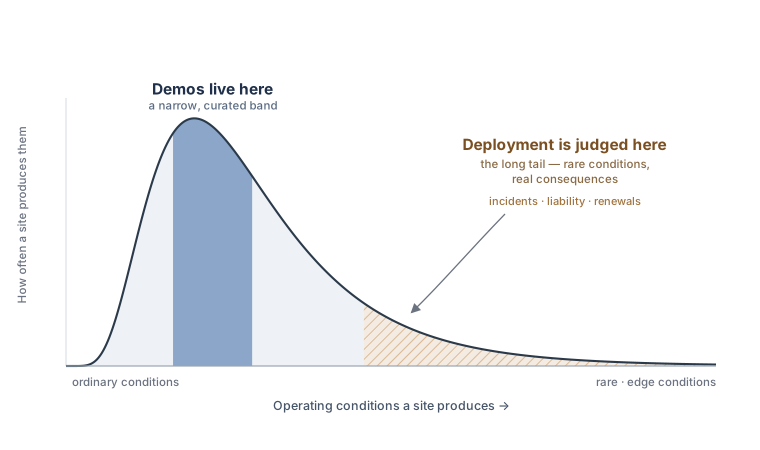
A demo occupies a narrow, curated band of operating conditions. Deployment is judged over the long tail of rare conditions with real consequences.
A site generates operating conditions on a distribution: the ordinary middle, and a long tail of rare combinations.
The reflective floor after mopping. The forklift and the visitor arriving in the same aisle. The seasonal sun angle that blinds a sensor for two weeks a year. The newly installed glass door that changes reflections. The temporary sign placed exactly where the map assumed free space.
A demo samples conditions selected for success. Deployment is judged by conditions selected by the world.
Learned controllers sharpen this picture in an uncomfortable way. They are strongest in the middle of their training distribution, which is exactly where demos are easiest to film. They are weakest in the tail, which is exactly where deployment is judged.
A demo therefore does not merely fail to measure deployment readiness. It often measures the region where the system is most likely to look competent.
Why the software playbook does not transfer
Much of internet software crossed its deployment gap with a famous method:
Ship the beta, watch it fail, patch, repeat.
The method worked because many software failures were recoverable, every crash produced traces, and every fix could reach every user at near-zero cost.
Physical AI loses the first property decisively, and that loss poisons the rest.
No undo
A misjudged clearance is not an exception to catch. It is contact.
The cost of failure is asymmetric and sometimes irreversible. This caps the tolerable failure rate long before a learning curve would flatten on its own. A chatbot can hallucinate and be corrected. A robot sharing space with a patient, a worker, a child, or a visitor does not get the same luxury.
You cannot ship-to-learn
Software accumulated much of its reliability evidence by deploying.
For machines in shared spaces, the evidence needed to justify deployment cannot come primarily from the deployment itself. Collisions are not an A/B test anyone signs off on.
The gap has to be closed largely in advance, with rehearsed evidence: simulation, structured trials, stress tests, operational constraints, monitoring plans, and guarantees that hold under stated assumptions.
Whether simulated evidence transfers to reality — and who pays when it does not — is a fight of its own. I will return to it in a later post.
The site drifts
Cloud software can often define, instrument, and reproduce much of its operating environment. A robot’s environment is someone else’s building.
Renovations change the map. New hires change the traffic patterns. Seasons change the light. A new cleaning schedule changes the floor. A software update changes the robot.
The distribution you validated against last quarter is not necessarily the one you operate in next quarter. The update you push tonight quietly changes what last month’s sign-off was a sign-off of.
Validation is not a milestone here.
It decays.
Not only a model problem
It is tempting to file all of this under “the models are not good enough yet,” and to expect scale to close the gap.
Some of it, yes. Better perception and better policies genuinely shrink the tail. Better data, better simulation, better world models, better control, and better evaluation will matter.
But three questions survive any model improvement, because they are not properties of a model.
First — what exactly is being promised for this site?
Second — on what evidence would a reasonable skeptic (an operator, a certifier, an insurer, or a lawyer) accept the promise?
Third — who owns the risk that remains after the promise is kept?
Today those questions often have no clear owner.
The vendor is rewarded for a persuasive pilot. The operator inherits the residual risk of routine operation. The procurement document describes performance. The safety document describes responsibility. The technical report describes benchmarks. The insurance discussion describes exposure.
Too often, these documents do not reference one another.
That, more than any single technical limitation, is why so many fleets remain “in pilot” long after the demo was approved.
The bill is arriving
For a while, the demo was a business model.
Videos raised rounds, and rounds funded videos. That loop has not disappeared, but it is tightening. Buyers and boards are increasingly pricing deployment rather than possibility.
Procurement teams ask what happens after the pilot. Safety officers ask who signs off on mixed human-robot operation. Insurers ask how to price systems with little actuarial history. Certifiers confront controllers whose behavior is a statistical claim rather than a code listing. Operators ask who answers the phone when the system works 99.5% of the time but fails during the 0.5% that matters.
The deployment gap is becoming expensive to ignore.
The expense is measured not in views, but in stalled fleets, unsigned contracts, delayed rollouts, and pilots that never become operations.
Naming it
What crosses a gap like this is not a bigger demo.
It is a discipline: one that produces evidence instead of footage, states the assumptions under which the evidence holds, monitors when those assumptions decay, and assigns the risk that no evidence can remove.
Pieces of that discipline already exist. They are scattered across safety engineering, statistics, control theory, certification practice, operations research, and field robotics. But in most physical AI projects, they do not yet form a shared language or a clear owner.
I will call that discipline Physical AI Deployment Assurance.
The next post is about what belongs inside that name.
Views are my own and do not represent my employer or any organization I advise.